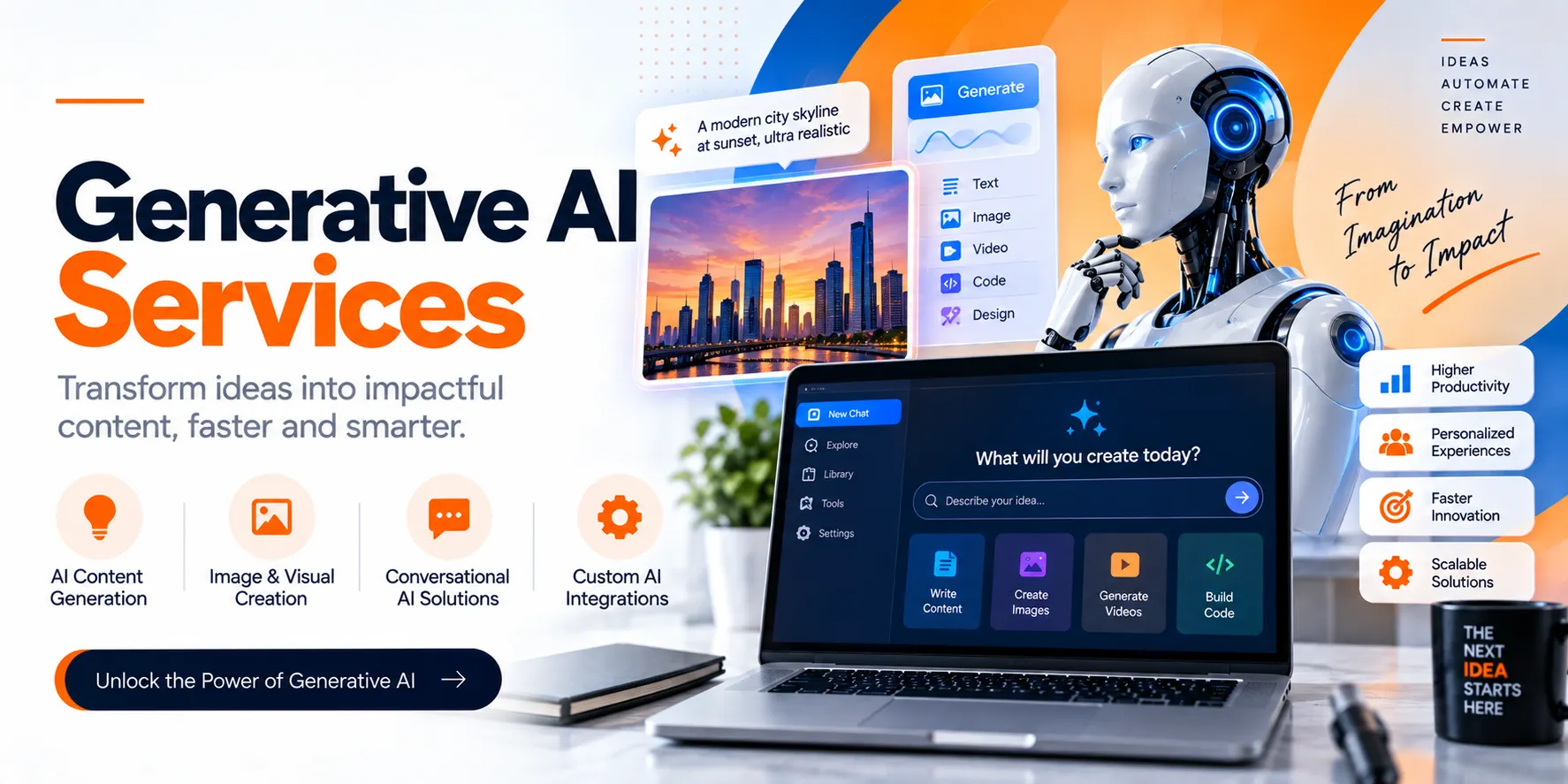
Deploying consumer chatbots or standard API wrappers without domain tuning exposes organizations to hallucination risks, data leakage, and generic outputs. TechQRT’s Generative AI Services deliver private, domain-adapted generative architectures engineered for enterprise security, deterministic accuracy, and automated production workflows. By combining foundational model tuning with advanced Retrieval-Augmented Generation (RAG) and multi-agent orchestration, we convert unstructured enterprise knowledge into reliable, high-utility operational assets.
Core Architecture & Engineering Capabilities
- Private Retrieval-Augmented Generation (RAG) Architectures: Building multi-stage retrieval pipelines connecting vector databases (Pinecone, Qdrant, PGVector, Chroma) with internal enterprise knowledge repositories, PDFs, policies, and ERP databases for hallucination-free, cited factual synthesis.
- Enterprise LLM Fine-Tuning & Quantization: Adapting open-weights models (Llama, Mistral) and proprietary LLMs via parameter-efficient fine-tuning (PEFT, LoRA, QLoRA) on private corporate datasets to master domain terminology, compliance rules, and internal brand style.
- Autonomous AI Agents & Tool Calling: Developing goal-oriented agentic workflows using orchestration frameworks (LangChain, LlamaIndex, Semantic Kernel) that can parse unstructured queries, query internal APIs, trigger backend database functions, and execute complex multi-step actions.
- Multimodal Generation Pipelines: Engineering end-to-end multimodal systems capable of ingesting, reasoning over, and generating cross-modal outputs—including technical document extraction (OCR + layout parsing), synthetic audio/speech synthesis, image generation, and automated code generation.
- Enterprise Guardrails & Data Privacy Firewalls: Implementing strict data sanitization (PII masking), prompt injection defense, automated red-teaming, output toxicity filtering, and role-based context fencing to ensure full corporate governance and data isolation.
Enterprise Architectural Stack & Operational Roles
- Model Tier & Fine-Tuning: Leveraging high-performance Python libraries (PyTorch, Hugging Face Transformers) alongside optimized model weights to execute parameter-efficient tuning, model distillation, and low-bit quantization for cost-efficient GPU inference.
- Vector & Embedding Infrastructure: High-dimensional embedding pipelines generating semantic representations stored in scalable vector stores, supported by hybrid keyword-vector search and re-ranking models (Cross-Encoders) for precision retrieval.
- Backend Orchestration & Middleware: Asynchronous Python (FastAPI) and .NET Core backends managing context window orchestration, token streaming, state persistence, caching, and rate limiting.
- Integration & Frontend Interfaces: Seamlessly surfacing generative assistants across enterprise web portals (React.js), cross-platform mobile applications (Flutter, React Native), and internal communication channels (Slack, Microsoft Teams, WhatsApp Business API).
- LLMOps & Continuous Observability: Real-time logging of token consumption, latency budgets, cost-per-query metrics, semantic drift, and automated evaluation suites (evaluating retrieval context precision, faithfulness, and answer relevance).
End-to-End Implementation Lifecycle
- Use-Case Scoping & ROI Feasibility: Identifying high-value generative use cases—such as automated customer support, underwriting analysis, contract analysis, and executive summarization—while establishing strict latency, budget, and accuracy benchmarks.
- Data Ingestion, Chunking & Vectorization: Cleaning, parsing, and chunking proprietary enterprise documents, configuring semantic boundary preservation, and populating encrypted vector indices.
- Prompt Engineering & Pipeline Construction: Designing structured system prompts, deterministic JSON schema outputs, few-shot demonstration exemplars, and fail-safe fallback policies.
- Security Auditing & Red-Teaming: Subjecting the generative system to adversarial prompt injection testing, jailbreak attempts, and factual consistency checks to calibrate guardrail thresholds.
- Production Deployment, Monitoring & Cache Tuning: Zero-downtime containerized deployment, configuring semantic caching (Redis) to reduce redundant LLM token costs, and tracking user feedback loops for continuous prompt and retrieval optimization.
By uniting state-of-the-art foundation models with enterprise-grade data guardrails and low-latency full-stack integration, TechQRT transforms generative AI from experimental novelty into secure, high-ROI business intelligence.